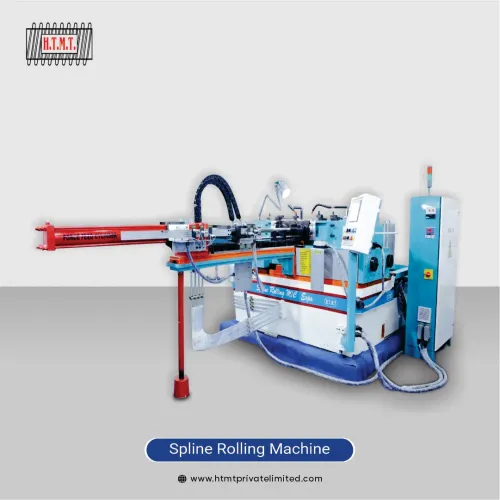
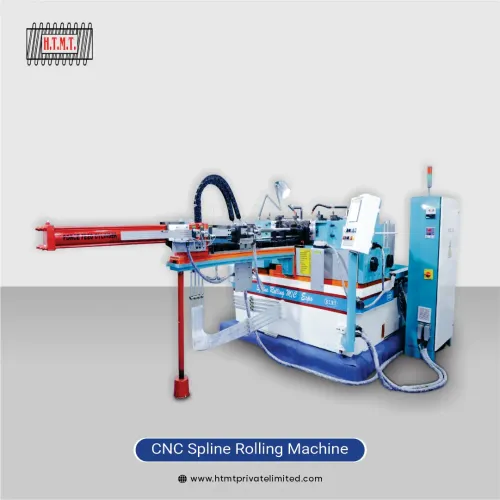
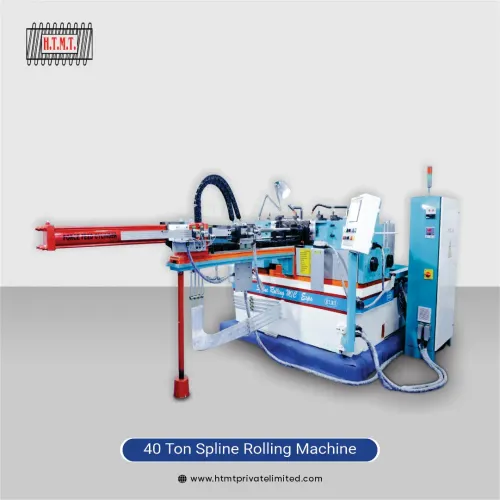
As one of the leading Spline Rolling Machine Manufacturers in India, we specialize in delivering high-precision machines for modern industrial applications. The machines we manufacture are built to roll splines with precision, consistency, and durability. The latest developments in metal forming technology, stringent quality control regulations, and customized tooling guarantee that all of our spline components created by our dedicated team will pass or exceed all of the requirements established by ISO Standards, which are used worldwide. Our Spline Component Manufacturer clients include Automotive, Aerospace, Heavy Equipment Manufacturers, and Others.
Key Points for Manufacturers of Spline Components:
- In-house R&D for customized spline profiles and die designs
- Machines capable of handling multiple shaft diameters in one setup
- Precision calibration tools are included with every machine
- Use of high-strength alloys to extend machine lifespan
- Training programs for operators on optimal machine usage
Spline Rolling Machine Suppliers in India – Trusted for Quality and Performance
As trusted Spline Rolling Machine Suppliers in India, we provide ready-to-deploy machines suitable for a variety of materials, shaft diameters, and industrial applications. Our machines accommodate everything from small-batch production to high-volume manufacturing. When considering budgets, industries often compare the spline rolling machine price in india. We ensure transparent pricing with options for hydraulic, mechanical, and CNC machines — all backed by full technical support.
Supplier Advantages:
- Pre-shipment testing for performance under load
- Option to include complete die sets with machines
- Assistance in installation and integration into existing production lines
- Documentation and operational manuals for easy use
- Flexible warranty and maintenance packages
Spline Rolling Machine Dealers in India – Experts You Can Trust
As a proficient Spline Rolling Machine Dealer in India, we guide clients during the purchase and installation process to make it easy and less complex to acquire a machine. We are here to help you throughout the long-term support stage of owning a machine. Clients searching for spline rolling machine near me benefit from our local presence and service network, including on-site inspections, operator training, and maintenance guidance.
Dealer Support Benefits:
- On-site demonstrations before purchase
- Assistance in selecting the right die configuration for specific shafts
- Access to genuine replacement parts and consumables
- Scheduled maintenance visits for optimal machine performance
- Quick-response service teams to minimize downtime
Spline Rolling Machine Exporters in India – Delivering Quality Worldwide
Serving as reliable Spline Rolling Machine Exporters in India, we deliver machines globally that meet the highest international standards. Our machines are suitable for producing complex spline profiles, internal/external splines, and custom shaft features. For many global clients, the best spline rolling machine is defined by precision, durability, and long-term operational efficiency, all of which we prioritize.
Exporter Highlights:
- Machines are packaged and shipped according to international logistics standards
- Compliance with ISO and other global certifications
- Technical training and virtual support for overseas clients
- Ability to handle high-volume global production requirements
- Customizable machines for unique international client specifications
Understanding Spline Rolling: Process, Benefits, and Industrial Relevance
What is Spline Rolling and How It Works
Spline Rolling, a cold forming technique, is when hardened dies or racks are used to deform a cylindrical workpiece by placing it between centres to create splines (ridged teeth) on the outside of the cylindrical part. Instead of cutting or material removal, spline rolling displaces material, which results in stronger, work‑hardened surfaces and excellent structural integrity.
Modern spline rolling machines — especially CNC‑controlled ones — press symmetrical dies onto the shaft. The dies rotate and gradually imprint the desired spline profile as the shaft rotates between centers. This ensures consistent geometry, exact tolerances, and smooth surface finish.
Advantages of Spline Rolling Over Traditional Methods
- High strength & durability: The cold‑forming process work‑hardens the surface, often giving 20–50% better fatigue strength compared to cut splines.
- Excellent surface finish & precision: Spline rolling delivers smooth, uniform splines with tight tolerances — often with surface finishes as fine as Ra 0.05 µm
- Increased profitability and reduced waste: With spline rolling, there is no material cut away from the workpiece. Therefore, there are no chips to dispose of, and the raw material to final component utilization is maximised. In addition, the rate of production of the circular part is much faster than either milling or broaching.
- Repeatability and increased production: Once the machine has been set up with the proper dies/tooling, the machine will continue to produce identical spline parts month after month with very little variation.
Because of these benefits, spline rolling is the preferred method of producing shafts, gear components, transmission parts, and axles by the automotive, gear manufacturing, power transmission, heavy machinery, and aerospace industries.
Types of Spline Rolling Machines & Their Use-Cases
Rolling machines vary by design, driving mechanism, and control type — each suited for different industrial requirements.
The following are the main types of spline rolling machines used in modern manufacturing today.
Mechanical & Hydraulic Spline Rolling Machines
Mechanical and hydraulic spline rolling machines, as their name implies, are constructed using mechanical or hydraulic systems to press dies onto shafts. They are cost‑effective, robust, and suitable for small to medium batch production or workshops where advanced CNC control is not necessary. Many foundries and small manufacturers use hydraulic spline rolling for steel or alloy shafts with moderate precision needs.
CNC & Servo‑Controlled Spline Rolling Machines
For highest precision, repeatability, and complex spline geometries (internal/external, helical, serrations, threads, etc.), CNC spline rolling machines are the go-to choice.Spline rolling machines can be designed for different spline modules, shaft diameters, and materials using programmable controls, which reduce error and simplify tooling changeover times, and increase production volume consistency by automating the manufacturing process.
Internal / External Spline Rollers & Specialized Configurations
Depending on the application, machines may be configured for external splines, internal splines (inside hollow shafts), or even special forms like serrations, gear teeth, or oil‑grooves. Some machines use circular dies suitable for long shafts or repeated spline sections; others use rack‑die systems for shorter components or simpler profiles. This versatility makes spline rolling suitable across many mechanical and automotive components.
Custom & Multi‑die / Multi‑geometry Rolling Machines
Modern spline rolling machines also allow for several dies to be mounted simultaneously, enabling the production of a single part with multiple combined features (e.g., splines, threads, and serrations) in one operation cycle. This allows for the production of motor shafts, gear assemblies, and other types of components with many features, improving process efficiency and reducing the overall time to produce parts.
Industries & Applications Where Spline Rolling Machine Shines
Automotive & Transmission Shafts
In the automotive industry, shafts with properly sized splines are essential for the operation of automatic transmissions, drive shafts, power steering columns, and other transmission systems. By using a spline rolling machine to manufacture these shafts with high precision, manufacturers are able to create shafts that can transmit high levels of torque with minimal play, resulting in an incredibly smooth operating experience and a long life for the shaft being produced. Manufacturers prefer to use rolling rather than cutting or broaching to manufacture splines because rolled splines are stronger than cut or broached splines and have superior fatigue resistance.
Heavy Machinery, Power Transmission & Industrial Equipment
For heavy-duty applications, such as pumps, compressors, and industrial gearboxes, spline-rolled components have great reliability for strength and durability. In addition, cold-forming the spline mechanically constrains the material to withstand high loads and dynamic mechanical loads from cyclic torque, making rolled splines extremely well-suited for all heavy-duty applications found in the industrial marketplace.
Aerospace, Defense & Precision Engineering
The finish of the Spline rolled to a higher level than required results in an excellent surface finish, precise dimensional accuracy, and consistent properties of the material used to manufacture Spline components. These characteristics make Spline rolling an excellent choice for manufacturing Aerospace, Defense, and Other Specialty Machinery Spline Component Manufacturers that require exceptional reliability, consistent performance, and high levels of strength and rigidity. To ensure your machine can produce Spline parts, be sure to check that you know the component's dimensions, its diameter tolerance specifications, and what the raw material (i.e., Carbon Steel, Alloy Steel, Aluminum...) should be for the Spline rolling machine you have installed on your floor.
OEM & Aftermarket Gear & Shaft Manufacturing
Original Equipment Manufacturers (OEMs) and aftermarket manufacturers frequently have high-volume requirements for producing spline shafts, gears, and transmission components consistently over time. Spline rolling machines that incorporate CNC technology or multiple dies are very effective for these purposes as they allow for rapid processing rates (throughput), require very little rework, and produce a consistent product.
How to Choose the Right Spline Rolling Machine for Your Needs
1. Material & Shaft Specifications
Check the material and its diameter and/or tolerance prior to using the spline rolling machine. The spline rolling machine will need to be capable of handling both the diameter range and the hardness of the material(s) being rolled, such as carbon steel, alloy steel, aluminum, etc.
2. Spline Geometry & Complexity
If you need standard involute splines, a hydraulic/mechanical roller might suffice. But for complex geometries — internal splines, serrations, threads, multi‑features — a CNC or multi‑die spline rolling machine is preferable.
3. Production Volume & Repeatability Requirements
For small batch runs or prototypes, a simpler style rolling machine may be sufficient. However, for high-volume/high-consistency requirements (i.e. industrial or automotive), select a rolling machine that incorporates CNC technology or automation with rapid die-changing capabilities, and provides high repeatability,
4. Precision & Surface Finish Demands
For applications where surface finish, fatigue strength, and tight tolerance matter (e.g., aerospace, transmission shafts), choose machines capable of high precision — with precise die alignment, backlash‑free drives, and proper calibration tools.
5. Tooling Flexibility & Maintenance Support
Machines that support interchangeable dies, allow quick tooling changes, and offer spare parts + maintenance support give a long-term advantage. Also, evaluate after-sales service when buying from suppliers or dealers.
Why Choose Us for Your Spline Rolling Needs
- We are full‑fledged Spline Rolling Machine Manufacturers in India with decades of experience — ensuring robust build quality, precise engineering, and reliable output.
- As Suppliers and Dealers, we provide ready-to-install machines, technical guidance on configuration, on-site support, installation, and operator training.
- For international clients, we serve as Exporters, delivering machines with global standard compliance, proper packing, documentation, and after-sales support for overseas deployment.
- We offer both Hydraulic / Mechanical and CNC (Computer Numeric Controlled) Spline rolling machines, thus ensuring flexibility to serve any size of operation, including small, medium, and large workshops, factories, and specialised Industries.
- Our customer-centric philosophy places heavy emphasis on the Customer First approach, which means providing clear communication of our pricing, providing accurate consultations, offering engineered custom solutions, and providing our customers with the ability to obtain the best possible service from us if there are any issues with the machine.